작품의 기능
This device helps clean lakes by collecting trash and algae that float on the water surface. It works semi-automatically, so it needs very little human control. The aim is to make lakes cleaner, safer, and more beautiful for the environment and people.
영감의 원천
The inspiration for this project came from seeing the worsening condition of lakes in Malaysia, especially places like Danau Kota and Tasik Cempaka, where algae blooms and floating garbage are common. Our survey confirmed public concern-most respondents believed lake pollution affects health, and nearly 80% supported robotic cleaning solutions. Recognizing that existing solutions are too large, expensive, or limited in function, we set out to build a more practical, compact, and affordable alternative that can work in smaller lakes and be managed by local councils or universities.
작동원리
The machine floats on water and moves using paddle wheels. It has a conveyor belt system to collect trash and algae. Sensors help avoid obstacles, and it can be controlled remotely through Bluetooth. Solar panels provide extra power, making it energy efficient.
개발 과정
We began with six conceptual designs and used tools like the Pugh Matrix and House of Quality to identify the best features. The final design combines the durability of HDPE for the body, PETG for the paddle wheel, and PVC for the conveyor system. The components were modeled using SolidWorks and verified through buoyancy tests, structural simulations, and motion analysis. We also considered ease of assembly, sustainability, and maintenance. Every decision was made to balance performance, cost, and real-world usability, especially in Malaysian environments.
독창성
Unlike manual cleaning or simple machines, this cleaner can run automatically, use solar power, and has sensors to avoid obstacles. It’s also designed to be lightweight and low-cost, which makes it suitable for small lakes or ponds.
향후 계획
This project began as an engineering design assignment, but we aim to take it further. Future improvements include adding solar charging, better motors for quieter operation, and smarter navigation using GPS. We hope to partner with local councils or environmental agencies to run pilot programs in Malaysian lakes. The long-term goal is to scale up production and provide a sustainable, low-cost cleaning solution for lakes and ponds nationwide, contributing directly to SDG 6 (Clean Water) and SDG 14 (Life Below Water).
수상 내역
작성자
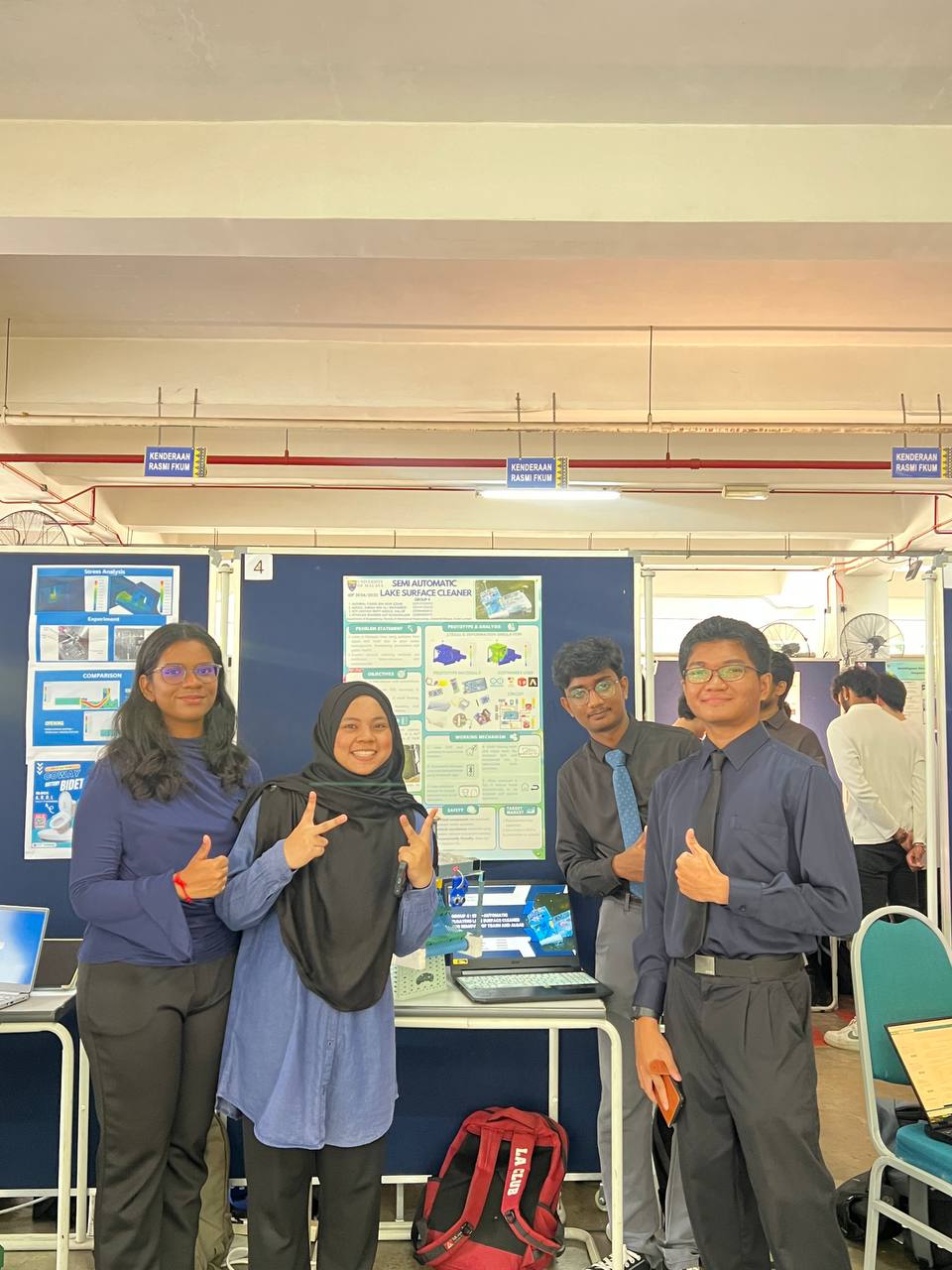
팀원
- VITHYAA RUHBINI
- AKHMAL FARIS NOR EZAM
- SITI AISYAH ABDUL HALIM
- ABDUL AIMAN BIN ALI MOHAMED
학교/수학기관
- Universiti Malaya
지역
- 말레이시아


이 페이지 공유